
Douglas County Court Records After a Jail Arrest
A Douglas County or East Wenatchee arrest may first appear as a jail-register entry at Chelan County Regional Justice Center or, less often, through the Okanogan County Corrections Center logs. That is the custody side. The court-record side begins when reports and probable-cause material reach the Douglas County Prosecuting Attorney and charges are filed in the proper court.
Washington uses the title Prosecuting Attorney rather than District Attorney. The Douglas County Prosecuting Attorney's Office is the charging office for county criminal matters after law-enforcement referral. The staff directory lists Sean Lewis as Prosecutor with phone 509-745-8535. Felony charges go to Douglas County Superior Court. Misdemeanors and gross misdemeanors generally proceed in Douglas County District Court or a municipal court, depending on the alleged offense, arresting agency, and city.
The jail roster and court records after arrest should be read together but not treated as the same record. For custody status, use jail inmate records. For booking photos and photo-release limits, use jail mugshots. For charges, dates, dispositions, and copies, use Washington Courts first and then the court where the case was filed, such as Douglas County Superior Court or Douglas County District Court.
How to Find Douglas County Court Records After an Arrest
Washington Courts operates the statewide search engine for cases filed in municipal, district, superior, and appellate courts. It can point to case summaries and hearing dates, but Washington Courts warns that the complete court record must be obtained from the court where the case was filed. It also says the search engine cannot be used as proof of someone's criminal history, because Washington State Patrol WATCH maintains state criminal-history information.
- Confirm custody or recent booking through the Chelan jail registry or Okanogan inmate log, understanding that booking information is not the final charge record.
- Open Washington Courts Find My Court Date or the statewide case search.
- Search by defendant name or case number. Use a case number when it appears on citation, bond, release, or court paperwork.
- Filter to Douglas County Superior Court, Douglas District Court, Douglas District Court - Bridgeport, East Wenatchee Municipal Court, or Grand Coulee Municipal Court when the search path allows it.
- Read filed charges and status carefully, then verify complete documents, certified copies, older files, and dispositions with the local court clerk.
- Use WSP WATCH for statewide criminal-history reporting rather than treating a jail entry as a conviction record.
Timing is a documented limit. Washington Courts says its search engine updates approximately 24 hours from the time clerks enter information. A person can be in regional jail custody before a searchable court case appears, and a case can exist in court after the person has been released or transferred.
The Washington Courts Find My Court Date site explains statewide case-search limits and directs users to the filing court for complete records.
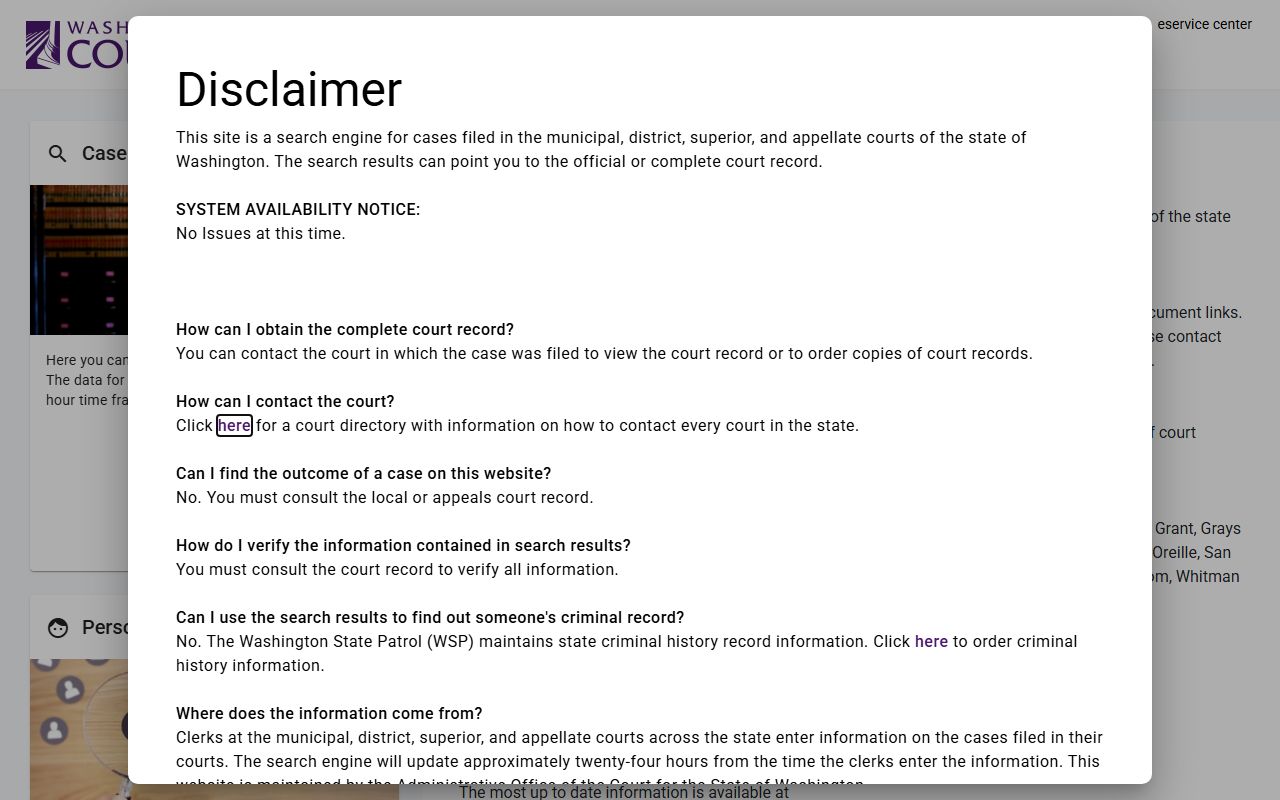
For Douglas County court records after a jail arrest, use the statewide search to identify the case, then confirm the complete record with Superior, District, or Municipal Court.
Court Search Fields for Records After Arrest
The Washington Courts case search includes statewide courts and several Douglas County choices. The exact fields vary by tab, but the research documented the following search filters and inputs.
| Field Label | Type | Required | Options or Format Notes |
|---|---|---|---|
| Court level or tab | Tab or dropdown | Unspecified | Superior courts, courts of limited jurisdiction, and appellate courts. |
| Court Name | Dropdown or list | Optional filter | Includes Douglas County Superior Court, Douglas District Court, Douglas District Court - Bridgeport, East Wenatchee Municipal Court, and Grand Coulee Municipal Court. |
| Case Type | Dropdown or list | Optional | Civil, Criminal, Domestic, and Probate/Guardianship were visible for superior court. |
| Person or business name | Text | Varies | Name search; exact field labels vary by search path. |
| Case number | Text | Optional alternative | Best when known from court or jail paperwork. |
| Date or court date | Search path | Optional | Used through the Find My Court Date route for hearing information. |
The Washington Courts case search form shows the court dropdowns and case type options used to narrow a Douglas County search.
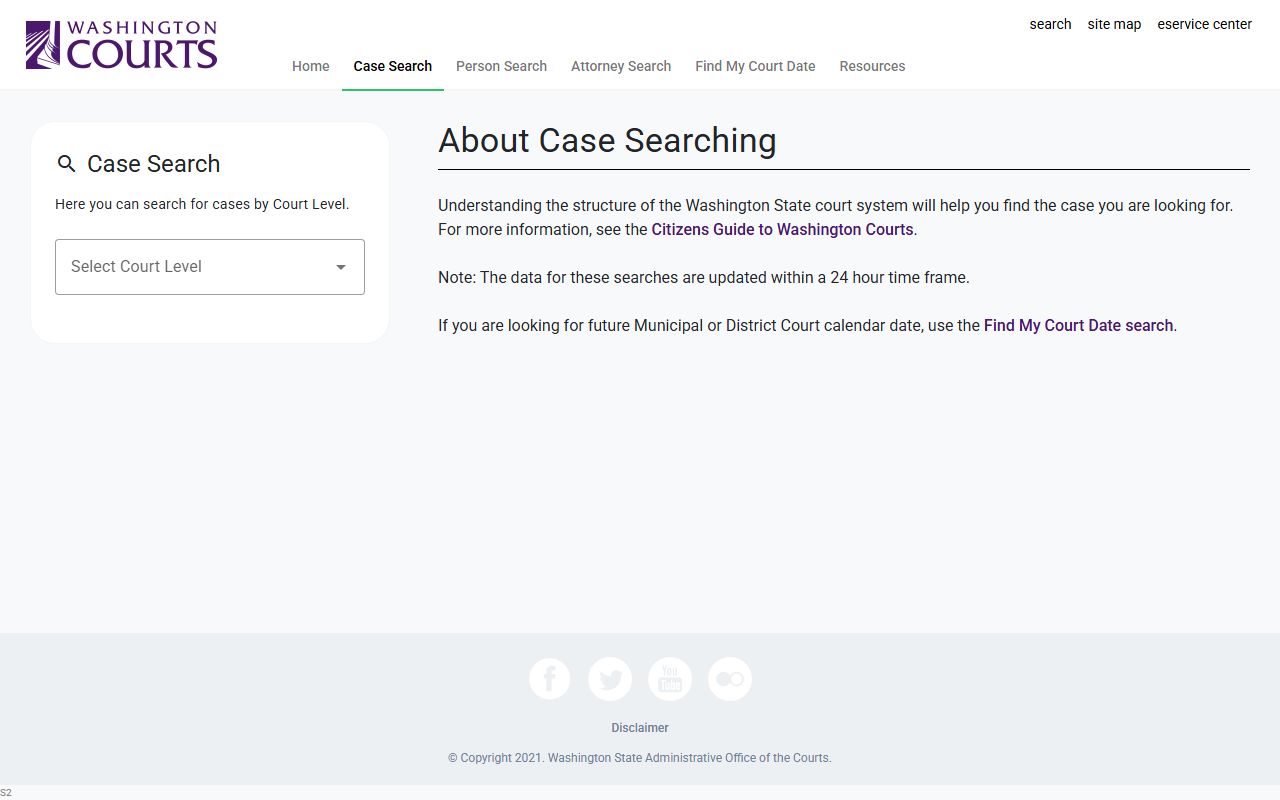
When the case search returns a likely match, the local court remains the source for complete, official, certified, or older records.
How Charges Get Filed After an Arrest
Booking charges are not always the charges that become the court record. Law enforcement may arrest on probable cause, a warrant, or a citation. The prosecutor then reviews reports and decides whether to file, decline, amend, add, reduce, or dismiss charges. Misdemeanor matters often proceed by complaint or citation in district or municipal court. Felonies are filed in Superior Court, commonly by information after prosecutor review, with indictment reserved for rarer grand-jury contexts.
| Complaint or Citation | Information | Indictment | |
|---|---|---|---|
| Filed By | Officer or prosecutor, depending on case path | Prosecutor | Grand jury |
| Common For | Misdemeanors, gross misdemeanors, and lower-court matters | Many felony cases after prosecutor review | Less common serious felony charging route |
| Usually Filed In | District or municipal court | Superior Court | Superior Court or federal court, depending on authority |
| Starts | The court case or lower-court charge track | The formal felony case | The case based on grand-jury action |
Charge Status in Court Records After an Arrest
Charge status can change after the first court entry. A jail roster may reflect arrest allegations or custody status, while the court docket reflects what has been filed and how the charge is moving. Use the charge status in the court record only after confirming the case and the filing court.
| Status | What It Means |
|---|---|
| Pending | The charge has not reached final disposition. |
| Filed | The prosecutor or court has opened the charge in the court record. |
| Amended | The original charge has been changed through prosecutor or court process. |
| Reduced | A lesser charge replaced the original or more serious allegation. |
| Dismissed | The charge ended without a conviction on that charge. |
| Convicted or found guilty | The court entered a guilty disposition by plea, verdict, or finding. |
| Acquitted or not guilty | The court found no guilt on that charge. |
| Deferred | A court-supervised resolution may lead to dismissal if conditions are met, depending on case type. |
Bond and Release After an Arrest
Bond and release information often comes from the court, the jail phone tree, or paperwork, not the visible Chelan public roster row. The CCRJC phone tree is 509-667-6462. The documented options include option 0 for Court Info, option 2 for Records/Property Release, option 4 for Work Release/EHM, and option 5 for Jail Administration/Accounts. The CCRJC trifold includes bail bond agencies, but the official sources inspected did not locate a full bail payment method table or exact bond payment fees.
| Bond Type | How It Works |
|---|---|
| Cash bail or bond | Paid directly to the court or jail as instructed; refund or forfeiture depends on court orders and case outcome. |
| Surety bond | A bail agent posts bond and the user pays a nonrefundable premium or fee to the agent. |
| PR or own recognizance | Release without upfront bail, based on a promise to appear and comply with court conditions. |
| Conditional release | May include no-contact orders, alcohol or drug monitoring, EHM, or work release when court-approved. |
| No-bond hold | Payment will not release the person until the holding court or agency clears the hold. |
Warrants That Lead to an Arrest
No official Douglas County Sheriff's active warrant list was located in the inspected sources, so a warrant lookup must use a fallback chain. Check Washington Courts for case status and failure-to-appear events in Douglas County Superior Court, Douglas District Court, East Wenatchee Municipal Court, Bridgeport Municipal Court, or Grand Coulee Municipal Court. Contact the issuing court for bench-warrant questions. Contact Douglas County Sheriff's Office at 509-884-0941 for law-enforcement warrant or process questions.
DOC warrants are different. The Washington DOC warrant search lets users browse or search by first name, last name, DOC number, crime, or county, and the page warns that photos may be included if available. That system covers people under DOC authority or supervision, not every county, district, municipal, or superior-court warrant.
Charges vs. Convictions
An arrest and a filed charge are accusations or procedural steps, not a conviction. The court record after an arrest can show filed charges that later change, get dismissed, or resolve without a guilty finding. For employment, tenant, credit, insurance, or other regulated decisions, use lawful FCRA-compliant channels and verified official records.
| Charge | Conviction | |
|---|---|---|
| Stage | Accusation filed in court or alleged in the case | Final guilty disposition by plea, verdict, or finding |
| Proof Level | Begins from probable cause or prosecutor filing standard | Requires proof beyond a reasonable doubt or a valid guilty plea |
| Can Change | May be amended, reduced, added, declined, or dismissed | May later be appealed, vacated, or otherwise modified only through legal process |
| Public Record | Often visible in court indexes, subject to limits | Often visible in court or criminal-history records, subject to limits |
Sealed, Vacated, and Restricted Arrest Records
Washington access rules are more specific than a simple public or private label. RCW 42.56 is the Washington Public Records Act, but exemptions and separate confidentiality statutes still apply. RCW 70.48.100 makes the jail register open while treating broader records of a person confined in jail as confidential unless an exception applies. Court records can also be sealed, restricted, or affected by vacation statutes.
| Sealed or Restricted | Vacated | |
|---|---|---|
| Visibility | Hidden or limited from ordinary public access by court rule or statute. | A conviction may be cleared for eligible offenses after statutory requirements are met. |
| Authority | Usually requires court order, rule, or specific confidentiality law. | RCW 9.96.060 covers eligible misdemeanor or gross misdemeanor convictions; RCW 9.94A.640 covers eligible felony convictions. |
| Limits | Law enforcement, courts, or agencies may retain access under limited rules. | Not all offenses qualify, and vacation does not automatically erase every agency copy or third-party copy. |
| Juvenile Records | Juvenile records are not handled like adult jail registers. | Juvenile sealing and confidentiality should be handled through juvenile court procedures. |
Background Check Considerations
Washington Courts expressly warns that its search engine cannot be used as proof of a person's criminal record. WSP WATCH is the statewide criminal-history channel identified in the research. A jail roster is even narrower because it shows current custody and jail-register information, not a certified criminal-history result.
Important: Do not use casual jail, court, or locator searches for FCRA-covered decisions such as employment, housing, credit, or insurance.
Restricted Court Records After an Arrest in Douglas County
Some records after an arrest may not be publicly available online. Juvenile matters, sealed cases, confidential law-enforcement materials, medical details, internal jail records, some victim information, and ongoing-investigation materials can be restricted. RCW 70.48.100 is especially important for jail records because it separates the public jail register from broader confidential records of a confined person.
For the complete court file, contact the filing court. Douglas County District Court is at 100 19th Street NW in East Wenatchee, with phone 509-884-3536, fax 509-884-5973, and hours Monday through Friday, 9 a.m. to 4 p.m. For Superior Court matters, use the Douglas County Superior Court resources and state case search links. For copy access and administrative-record limits, use the county's Access to Court Records page. For prosecutor questions, use the Douglas County Prosecuting Attorney's Office rather than the jail roster.